Candidate preparation guide
Police Exam Study Guide
Police Exam Study Guide explains police written exam preparation the way a careful candidate would approach it: learn the exact task, work through original examples, diagnose mistakes, and verify changeable rules against your current candidate handbook.
Quick answer
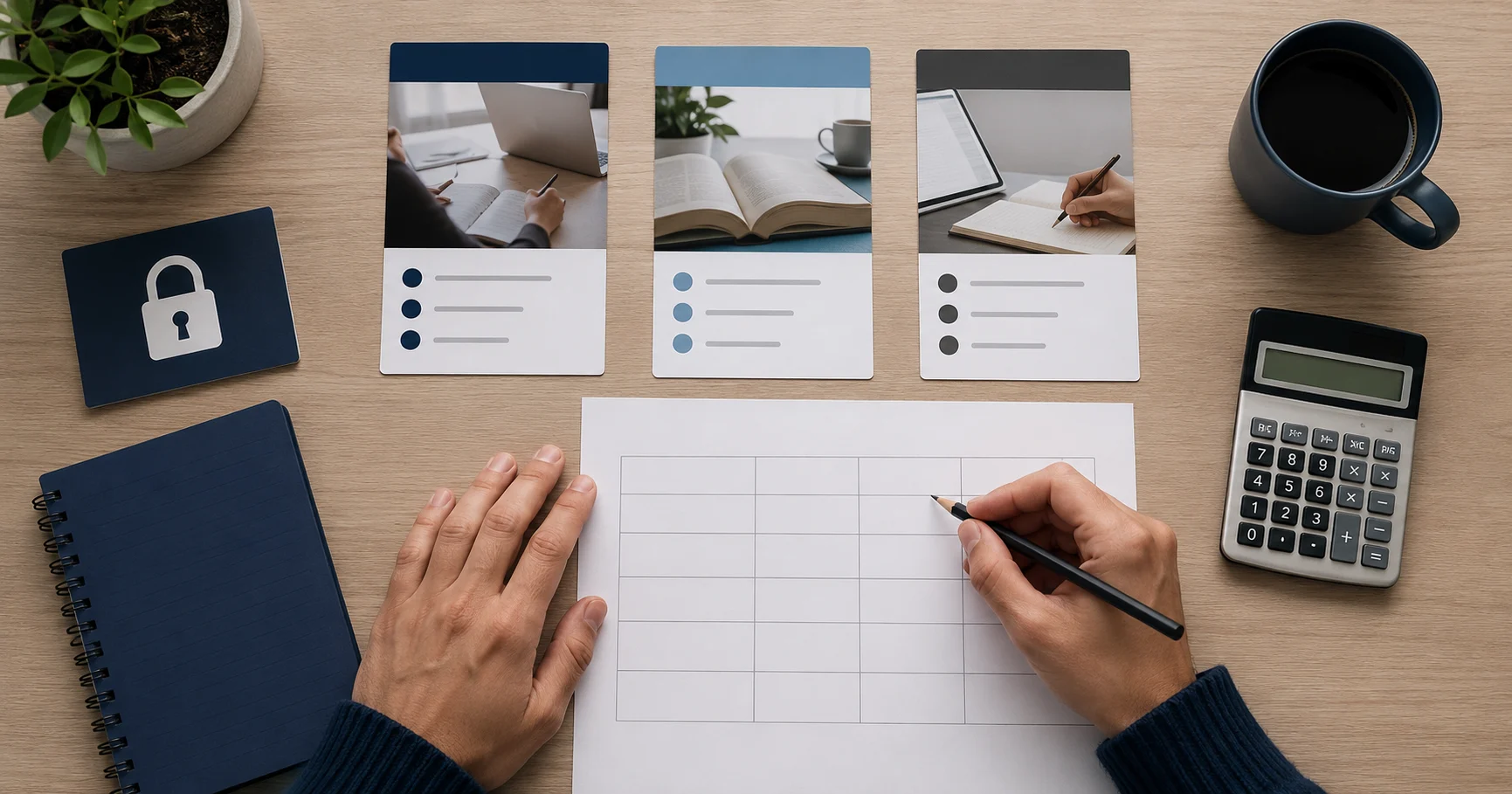
A useful police-exam study plan starts with the official section list, builds accuracy in each skill, then adds regular timed mixed practice. The exact test and timeline depend on the department.
Week 1 — establish the baseline
Read the official candidate guide and try a short diagnostic for each named skill. Record errors by category rather than judging yourself by one overall score.
Weeks 2 and 3 — practice deliberately
Use focused reading, writing, math, observation, or judgment sessions. Review explanations and redo the method later rather than cramming the answer.
Week 4 — simulate and prepare
Use mixed timed sessions, check logistics and required documents, sleep well, and keep the final review light. Follow the department's instructions if they conflict with any general study advice.
Build an 8-week plan when time allows
Use weeks 1 and 2 for baseline work and fundamentals, weeks 3 through 5 for targeted skill blocks, weeks 6 and 7 for mixed timed practice, and week 8 for 2 realistic simulations plus logistical preparation. Schedule at least 1 rest day each week. The extra time should increase review quality, not simply double the number of questions.
Section-by-section study method
For reading, cite the sentence supporting every answer. For written clarity, name the grammar, punctuation, or sequencing rule. For math, show units and estimate before accepting a result. For observation, separate what was seen from what was inferred. For judgment, explain why the best response is safer, lawful, proportionate, communicative, and properly documented under the facts supplied.
| Study block | Suggested time | Output |
|---|---|---|
| Learn | 10 minutes | A short rule or worked example in your own words. |
| Apply | 20 minutes | A focused set of new questions. |
| Review | 15 minutes | An error label and corrected method for every miss. |
| Retrieve later | 10 minutes | A fresh item 2 or more days later without notes. |
How to use a police test study guide
A police test study guide should help you decide what to do next. Mark each official section as strong, developing, or weak; connect it to a practice source; and schedule a review date. Remove any topic that is not on your current blueprint. Generic volume is less valuable than a plan that reflects the actual test named by your department.
Free police written-exam practice
Use the mixed diagnostic for original numerical, written-clarity, instruction-following, and record-accuracy questions, and use the flagship verbal test for deeper reading inference. This is free police written exam practice, not a replica of a protected assessment. Review the explanation after every item and keep a separate list of errors caused by knowledge, method, and time pressure.
How to judge a police written exam practice test
A strong police written exam practice test states the skill, uses unseen original material, provides plausible but unambiguous options, and explains the full method. A law enforcement written practice test should also distinguish factual reporting from invented conclusions and avoid assuming local law unless the source material supplies it. Track category accuracy and pace, then choose the next session from the error pattern instead of repeatedly taking full tests without review.
Build an error log that changes your next session
For every miss, record the date, section, question type, your answer, correct answer, controlling rule or fact, and a short error label. Useful labels include misread qualifier, unsupported assumption, wrong unit, chronology reversal, grammar rule, incomplete notes, and rushed choice. Add a retest date at least 2 days later with a new question. If the same label appears 3 times, schedule a focused lesson before another full mock.
Run a realistic simulation
Match only the conditions your official guide confirms: section order, response format, time, breaks, scratch paper, and calculator rule. Use unseen original questions. Put away notifications and do not pause to research. Afterward, separate the score from the review: first record category accuracy and pace, then examine every miss and every uncertain correct answer. A lucky correct choice still identifies a weak method.
Adjust the plan when your exam is close
With 2 weeks remaining, prioritize the 2 weakest high-weight skills and complete 1 mixed session every 3 or 4 days. With 1 week remaining, stop adding new resources and concentrate on repeatable methods, official instructions, and recovery. With 48 hours remaining, use only short retrieval drills and logistics. Cramming unfamiliar content can reduce sleep and confidence without fixing a documented weakness.
Hold a weekly evidence-based review
At the end of each week, compare your planned sessions with the work you actually completed. Record accuracy, pace, repeated error labels, and confidence separately; confidence alone is not evidence of improvement. Keep a method when results are improving across new questions, shorten it when it is accurate but too slow, and replace it when the same mistake persists after focused review. Choose no more than 2 priorities for the next week so the plan stays usable. This small review turns a generic timetable into a study system driven by your own performance.
Test-day logistics checklist
Re-read the official notice, confirm the date and location, check identification and permitted materials, plan travel with a buffer, prepare any accessibility arrangement through the authorized process, and sleep on your normal schedule. Do not introduce an unfamiliar study method, supplement, or extreme sleep change immediately before the exam.
Four-week and eight-week plans serve different baselines
Use 4 weeks when the fundamentals are already stable and the blueprint is narrow. Use 8 weeks when several sections need repair, allowing repeated retrieval and spaced simulations instead of doubling daily question volume.
A simulation must match the testing bulletin
Copy only confirmed conditions: section order, time, permitted calculator or scratch paper, breaks, and navigation rules. A harder but mismatched mock can produce impressive fatigue without measuring readiness for the actual written exam.
Take a mixed baseline
Use original reading, numerical, writing, instruction, and record-accuracy questions to decide which week of the plan needs the most time.
Continue preparingFrequently asked questions
Is a 4-week police exam study plan enough?
It can be enough for targeted review when your baseline is sound. Choose 8 weeks when several high-weight sections need rebuilding or the official reading list is substantial.
How often should I take full practice tests?
Use focused drills between simulations. One well-reviewed mixed test every few days is usually more informative than repeated full tests with no error analysis.
What belongs in a police exam error log?
Record the section, item type, your response, controlling rule or fact, error cause, and a date for a fresh retest.
What should I study during the final 48 hours?
Use short retrieval checks, review official logistics, and protect normal sleep. Avoid new resources and exhausting last-minute mock exams.
Keep preparing
 police examThe Complete Police Exam GuideRead the guide ->police examNYPD Police Officer Exam: Format & Prep GuideRead the guide ->
 verbal reasoningFree Police Verbal Reasoning Practice TestRead the guide ->police examPolice Exam Study Plan BuilderRead the guide ->corePolice Exam Practice Hub: Free Quizzes, Drills and Study ToolsRead the guide ->